
Grizzlies executive John Hollinger describes a predraft workout geared towards second-round picks. Ronald Tillery/The Commercial Appeal
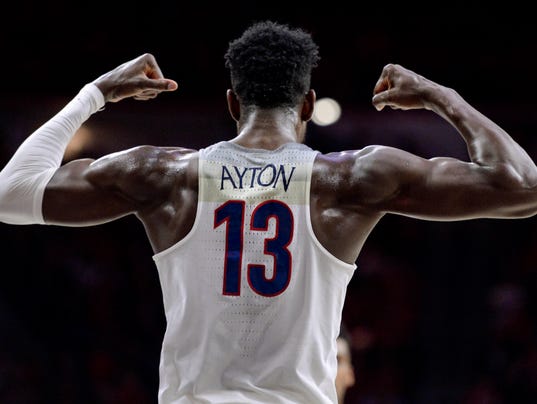
Deandre Ayton, forward, Arizona.(Photo: Casey Sapio, USA TODAY Sports)
The date the Memphis Grizzlies and many of its fans have been waiting on for far too long, the annual NBA draft lottery, is Tuesday night. We know that the Grizzlies are certain to have a Top 5 pick and that the landing-spot probabilities fall in this order: 4-1-2-3-5. We know that a pick this high, wherever it lands, guarantees nothing. But it does matter.
In January, Pick-and-Pop explored the general value of draft picks. Looking at 20 years worth of NBA drafts -- 1997-2016 -- we learned that Top 5 picks yielded stars more than 40 percent of the time. If that doesn't sound like much, consider: Picks 6-10 had a "star" hit rate of below 20 percent. Outside the Top 10: Less than 4 percent. The odds are never exactly in your favor, but the drop-off is steep.
A Top 5 pick secured, a new question emerges: Are there certain types of players within this range that tend to be more successful than others? Can you bend the odds?
By way of sequel, let's look at the history of those picks (Top 5 picks, 1997-2016) and apply it to this year's prospects. To do so, I divided all 100 players into seven player pools based on pedigree and production coming into the draft:
- Elite/Elite: Players who were consensus Top 10 high school recruits coming into college who were then instant, high-production stars in college. (I used consensus prospect rankings from Basketball Reference back to 1998 and Parade All-American teams for the few years before that.)
- Elite/Non-Elite: Consensus Top 10 high school recruits who either underperformed expectations as college freshmen or at least weren't clear stars.
- Non-Elite/Elite: Players who fell outside of the Top 10 in high school rankings but were instant-impact collegians who pushed themselves into the Top 5 of the draft after one or two college seasons.
- Slow Growers: Players who were not elite high school prospects but who developed into Top 5 picks after multiple college seasons.
- Productive Internationals: International prospects who put up significant professional production overseas.
- Speculative Internationals: International prospects who were not significant professional players overseas but were high picks anyway based on projected skills.
- Preps: Players who came into the NBA straight out of high school, a category that included eight of the 100 drafted players but which no longer applies.
How have these groups fared in the NBA and what does that say about this year's Top 5 candidates? Let's take them one at a time, and then offer some final reactions:

Marvin Bagley III, forward, Duke. (Photo: Charles LeClaire, USA TODAY Sports)
Elite/Elite
Success Rate: Of the 29 picks who fell into this category, I'd classify 18 as "stars" (62 percent), both the most of any category and the highest success rate. Seven slot as "good" and only four were "misses."
This Year's Models: A lot of time has been spent pitting DeAndre Ayton and Marvin Bagley III against each other in the run-up to this draft, but let's focus for a moment on what they have in common: They weren't only both consensus Top 10 prospects in their class, but Top 3. Per Basketball Reference, Bagley was #1 and Ayton #3. They weren't just good in college, they were great as true freshmen for elite programs in top conferences: Ayton averaged 20 points and 12 rebounds with a 63 percent effective field goal percentage (eFG). Bagley averaged 21 points and 11 rebounds with a 64 percent eFG. There are plenty of questions about their respective games, and we've all been picking them apart, but neither appears to have the kind of red flags that would prevent them from following this trajectory into the Top 5 of the draft.
A player who might fit this group: Bagley's teammate Wendell Carter Jr., the #7 player in his high school class who put up 14 points and 9 rebounds on 59 percent eFG despite sharing a frontcourt with Bagley. While he doesn't fit this discussion because no-one seems to consider him a Top 5 candidate, it's worth noting that Alabama point guard Collin Sexton was #6 in his high school class and was highly productive (19-4-4 averages) as a college frosh.
Hopeful Comparisons: This group is full of similar one-and-done big men whose combination of prep pedigree and immediate college production laid the path to NBA stardom, among them: Lamar Odom, Chris Bosh, Kevin Love, DeMarcus Cousins, Anthony Davis, Karl Anthony-Towns, and Joel Embiid. (Note: Embiid was actually #16 on the Basketball Reference list, but by the time his college season started he was considered a top 3 or 4 prospect. I bumped him into this group.)
Cautionary Tales: Of the four outright misses, two, Greg Oden and Jay Williams, had their careers derailed early by injury. The other two are the more relevant cautionary tales: Anthony Bennett and Jahlil Okafor. Bennett, like Michael Beasley (a member of this group I decided to slot into the "good" category), might be a Bagley worst-case: Positional tweeners with serious defensive questions. But I'd say the biggest obstacle faced by both Bennett and Beasley was more about their mental than physical make-up. It's hindsight now, but should ending up at UNLV and Kansas State, respectively, despite their elite high-school pedigrees, have been red flags? Okafor is more the worst-case for Ayton: A big-time prep and collegian who got lost in part because his game was too traditional and one-dimensional for a rapidly changing NBA. I'm not buying it. Ayton is a much better athlete with an already more diverse two-way skill set.
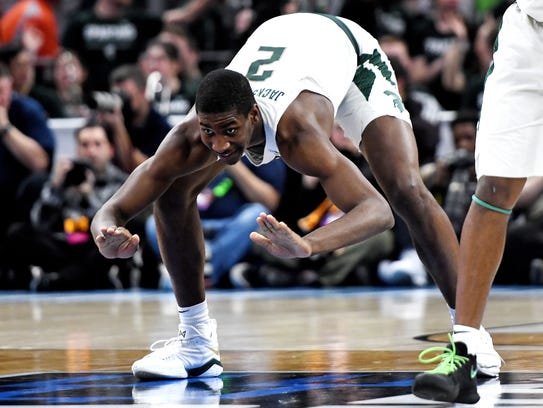
Michigan State's Jaren Jackson Jr. slaps the floor after a play during the first half on Sunday, March 18, 2018, at the Little Caesars Arena in Detroit. (Photo: Nick King/Lansing State Journal)
Elite/Non-Elite
Success Rate: There were 12 players who fit this profile: Top 10 high school prospects who weren't quite instant smashes in college but were taken in the Top 5 of the draft anyway. Of these dozen, only three have made the "star" cut and only two were "misses." Teams have been much more likely to find a merely good player (seven) in this group.
This Year's Models:Michael Porter Jr. (#2 in his class) would fit here, but it isn't so much that he underperformed in college as that he got hurt. The bigger question: Do Jaren Jackson Jr. and Mohamed Bamba go here or should they be in the Elite/Elite category? It's a bit eye-of-the-beholder. Bamba was the consensus #4 player in his high school class and averaged 13 points and 11 rebounds on 57 percent eFG at Texas. Jackson was the #9 player in his class and averaged 11 points and 6 rebounds on 60 percent eFG on a loaded Michigan State team. Both, and especially Jackson, went out with a whimper. That surface production is middling compared to Ayton/Bagley, but there are mitigating factors: Both Bamba and Jackson were elite shot-blockers as college freshmen. Jackson, the youngest player in this discussion, was also a high-level three-point shooter and team defender. Still: I'd argue that if either is a Top 5 pick, it's because of how teams are projecting their raw skills going forward, not as a consequence of their established history of production. So I think they belong here.
Hopeful Comparisons:Jaylen Brown (#3 in his high school class) and Aaron Gordon (#4) were both top prospects who followed those projections into the Top 5 on draft night despite not blowing the world away in college. Both seem on their way to all-star-caliber careers.
Cautionary Tales: There are some elite athletes here who didn't really pan out (Stromile Swift is the poster boy), but the most likely outcome is that all the improvement you project doesn't really pan out and you end up with a quality starter/rotation player but not a star: Marvin Williams, Derrick Favors, Tristan Thompson.

Trae Young, guard, Oklahoma. (Photo: Amy Kontras, USA TODAY Sports)
Non-Elite/Elite
Success Rate: Over the 20-year sample, there were only 7 players who were outside the Top 10 as high school prospects (again, moving Embiid into "elite") but were such instant hits in college that they quickly pushed themselves into the Top 5 of the draft. It's a small sample, but it's been a successful one, with four of the seven becoming stars and only one turning into a professional pumpkin.
This Year's Model: This is where you'll find Trae Young, who was #20 in his high school class and then exploded onto the college landscape with an eye-popping 27 points and 9 assists per game on 52 percent eFG.
Hopeful Comparisons: There are some good ones here for Young, led by Mike Conley (#21 in his class) and James Harden (#17). More reasonable: D'Angelo Russell, who was #16 in his high school class and jumped up to #2 in the draft after a dominant freshman season. Russell doesn't look like a star, but has been a good pro when healthy.
Cautionary Tales: Only once has the clock truly struck midnight on one of these players. Derrick Williams was only #100 in his high school class but jumped all the way to #2 in the draft after two great seasons at Arizona. It proved to be a bit of a mirage.

Mikal Bridges, guard/forward, Villanova. (Photo: Greg M. Cooper, USA TODAY Sports)
Slow Growers
Success Rate: Unsurprisingly, this is the biggest group, composed of 33 players. Most prospects take a little time to become NBA-ready, but projecting players who needed extra time in college has proven to be an even more uncertain exercise despite a larger sample to study. These players break down evenly among stars, good players, and draft misses: 11/11/11.
This Year's Model: There's really only one player in the current Top 5 discussion to whom this applies, and that's Villanova junior wing Mikal Bridges, who was #96 in his high school class and took three years in college to become a lottery pick.
Hopeful Comparisons: Among wings, Dwyane Wade and Victor Oladipo are
0 Response to "Pick-and-Popcast: Why a top 5 pick in this year's NBA Draft is a safer bet for the Grizzlies than most years - The Commercial Appeal"
Post a Comment