Produced by Josh Gelman, Alvin Patrick and Jaime Hellmann
Lorenzen Wright made headlines as the seventh overall pick in the 1996 NBA draft – but he also won the hearts of so many because of his impact on thousands of kids who were inspired by him.
That ended in July 2010 during a call to 911. The chilling recording captured the 34-year-old's dying word: "Goddamn." A dispatcher then heard repeated gunshots – 11 in all – unaware where it was happening or who was on the other end of the line.
"You can just listen to that tape and know he was in trouble," says Toney Armstrong, former director of police at the Memphis Police Department, who oversaw the investigation. "We literally threw everything we had at this investigation. We really wanted to solve it. We really, really wanted to solve this case."
As Memphis mourned, months turned into years and the city became obsessed with solving the murder of its favorite son. Then, seven long years after the murder, police got the break they needed.
Who wanted Wright dead, and how does a beloved basketball player's life end that way?
HOMETOWN HERO
Perched on the banks of the Mississippi River, Memphis, Tennessee, has always been a city of contrasts: famous for its place in music history and infamous for its place in the American civil rights movement.
Dr. Bill Adkins: Memphis is a city that, unfortunately, has been divided by race for many, many years.
Pastor Bill Adkins has been a long-time advocate for unity in the City of Memphis.
Dr. Bill Adkins | Lorenzen's mentor: It's a lot better than it used to be. But there are still divisions. Decisions … unfortunately, still made along racial lines.
But in a city divided, both racially and economically, there is something that brings people together.
Dr. Bill Adkins: Basketball in Memphis became -- a instrument of change … which brought races together. …You know, Memphis basketball was literally everything. And Lorenzen was a big part of that.
Once celebrated as one of Memphis' favorite sons, the memory of Lorenzen Wright still haunts this town.
James Brown | CBS News special correspondent: Put in perspective how big the Lorenzen Wright story is here in Memphis.
Marc Perrusquia: It's huge. I mean, Lorenzen Wright was a true hometown hero. He was beloved.
Marc Perrusquia has been writing for the Memphis newspaper, The Commercial Appeal, for almost 30 years.
Marc Perrusquia: We talk about big murders in the history of Memphis. You got Martin Luther King, OK, you can't trump that one, but he comes very close.
James Brown: That significant?
Marc Perrusquia: That significant.
Born in Oxford, Mississippi, Lorenzen Wright moved to Memphis to play basketball at Booker T. Washington High School. Being 6' 11" tall at 17 years old, he turned a lot of heads.
Dr. Bill Adkins: I decided to go take a look for myself.
James Brown: What did you see?
Dr. Bill Adkins: Oh, yeah, I saw this huge kid that could run the floor like a gazelle. …I mean, he could run the floor better than any big man I ever saw in my life.
Lorenzen went on to dazzle fans at the University of Memphis, but not for long.
LORENZEN WRIGHT [NEWS INTERVIEW] Thinking about what I'm going to be doing next year, whether I'm going to be at the University of Memphis or you know, in the NBA.
In 1996, he was drafted by the Los Angeles Clippers.
Dr. Bill Adkins: When he stepped up to that podium -- everybody just cheered. I mean, every -- every water hole, ever sports bar in this town had it on the TV screen. Everybody was watching. Everybody was cheering.
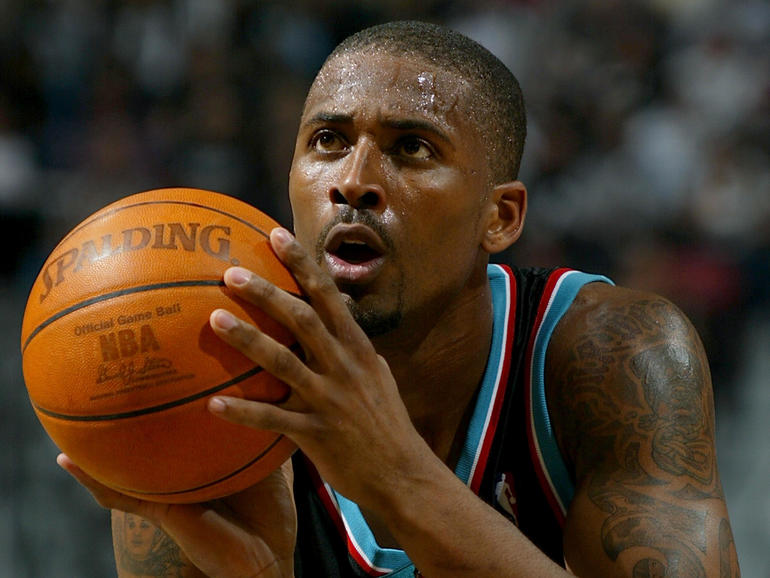
Lorenzen Wright, #42 of the Memphis Grizzlies, shoots a free throw during Game One of the Western Conference Quarterfinals against the San Antonio Spurs at the SBC Center on April 17, 2004 in San Antonio, Texas.
Ronald Martinez/Getty Image
Lorenzen Wright spent the next 13 seasons in the NBA, playing for five different teams around the country. He reportedly earned a career total $55 million.
Wright was known for his hard work on the court, but it was his work off the court that truly endeared him to his fans at home.
Phil Dotson: He never met a fan that he didn't like. He would sign every autograph that he came across.
Perhaps no one knew Lorenzen better than Phil Dotson, Wright's best friend and fraternity brother at the University of Memphis.
Phil Dotson: He … was always a pillar in the community. Always volunteered. Always would -- would be one of the first ones to raise their hand when the team would ask for a player to go into a children's hospital, or to go and speak at a school or an event. He was just that type of guy.
Gayle Rose: He was one young man who was working to make a difference … and he symbolized hope in our community.
Philanthropist Gayle Rose is as dedicated to the city of Memphis as Lorenzen was. They were once king and queen of the Mardi Gras.
Gayle Rose: My relationship was really about our mutual interest in Memphis … and that generous big heart of his.
It was Rose's son, Max, that brought them together at a summer basketball camp.
Gayle Rose: Lorenzen took a very special liking to Max. And you know, for Max at age 11, this is a hero, a real-life hero that he gets to be in the gym with.
Gayle Rose: Lorenzen is an example to every young boy ... it doesn't matter white or black ... that if you work hard and you have the gifts, that you can … get at this level. …He loved children.
He especially loved his own. Wright was the father of seven children. He married his high school girlfriend, Sherra Robinson, after his second season in the NBA.
Her father was one of Wright's high school coaches.
Phil Dotson: Lorenzen was in high school playing … for Sherra's father… and she would come to practices. …and I believe that's how they met.
Life in the NBA can be hard on a family -- working on the road, in cities far from home for months at a time, can stress even the best of marriages.
Dr. Bill Adkins: The arguments primarily were about two things: infidelity and finances.
Phil Dotson: Being married, and having kids at such an early age … He was, I think, forced to be an adult really quick. And at the same time … in that world, not really being focused on his relationship and his marriage as probably he should've been.
In 2001, Wright signed with the Memphis Grizzlies. He was back home with his family and with money in his pocket.
Phil Dotson: He had just signed a six-year, $42 million deal at that point.
It turns out though, that more money meant more problems.
Dr. Bill Adkins: They both, unfortunately, liked to spend. And I do mean spend. …Most married couples have trouble with lack of finances. His problem was affluence and how to handle that affluence. And that caused severe issues between him and his wife.
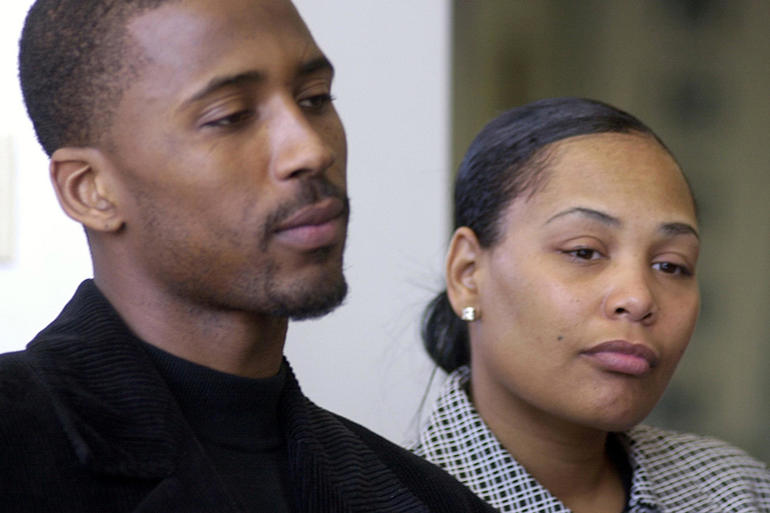
Lorenzen and Sherra Wright talk with the media about the death of their daughter Sierra
The Commercial Appeal
But it was a family tragedy in 2003 that would break Lorenzen's heart and eventually his marriage for good.
Phil Dotson: His daughter Sierra passed away of sudden infant death syndrome. She was probably around 11 months old at the time of her passing, which was very hard on him.
Over the next few years, Lorenzen and Sherra separated and later divorced. Lorenzen was traded to Atlanta, which he would call home after leaving the NBA in 2009, while Sherra and the kids stayed in Memphis.
SUNDAY JULY 18, 2010
Phil Dotson: I'd gotten a phone call from him that he had gotten in town…
Lorenzen often returned to Memphis from Atlanta to spend time with his kids.
Phil Dotson: That Sunday evening we had gone to pick up his son -- Lorenzen Jr. -- from the gym. He'd had been playin' basketball that evening.
Dotson says Sherra insisted Wright bring their son home to her house that night.
Phil Dotson: And, I ended up droppin' him off that night at about 10:00 p.m. ...And when I dropped him off, he said, "Let me go in here and deal with this. And I'll give you a call later."
But Lorenzen never called his friend that night. Instead, he called for help.
THE 911 CALL
Two days after dropping off Lorenzen at his ex-wife's home, his friend, Phil Dotson got an unexpected call. It was Lorenzen's mother – looking for her son.
Phil Dotson: "Have you talked to Lorenzen? I can't reach him." And I said, "Well, I figured he might just be outta town, he's not answerin' the phone call." So-- I reached out to him as well, and didn't hear anything back.
After not hearing from her son for more than 48 hours, Deborah Marion filed a missing persons report with the police.
April Thompson, an investigative reporter at WREG, the CBS affiliate in Memphis, was on this story from the start.
April Thompson: His mother Deborah, really kind of pushed that something's not right, and made people realize that he wouldn't have been gone this long that no one heard from him.
DEBORAH MARION [WREG NEWS REPORT]: … nowhere he could be that I don't know where he is … We checked all his friends from here to Atlanta, Mississippi, everywhere. So I don't have a clue.
April Thompson: It was really kind of strange in how it happened that he had disappeared, and he was gone over all of these days, and nobody knew anything.
PIC OF LORENZEN
Most troubling for Lorenzen's family was that he seemed to have disappeared without a trace.
DEBORAH MARION [WREG NEWS REPORT] Phone goes straight to voicemail. Just rings four times and goes straight to voicemail.
But what they didn't realize at the time was that Lorenzen had actually left behind a clue. On the 911 recording are his dying words and the sound of 11 gunshots:
911 CALL: Oh, Goddamn [BANG, BANG].
911 OPERATOR: Germantown 911, where's your emergency?
911 CALL: [BANG]
911 OPERATOR: Hello?
911 CALL: [BANG, BANG]
911 OPERATOR: Hello?
911 CALL: [BANG, BANG, BANG, BANG, BANG, BANG]
That frantic call was placed at 12:05 a.m. on the morning of July 19 -- just hours after Lorenzen was dropped off at Sherra's.
The
0 Response to "New twist in probe of slain NBA star Lorenzen Wright - CBS News"
Post a Comment